First Timer’s Guide to Agile Mobile Development: Exploring the different phases of mobile app development
Learn moreSwipe to Check More
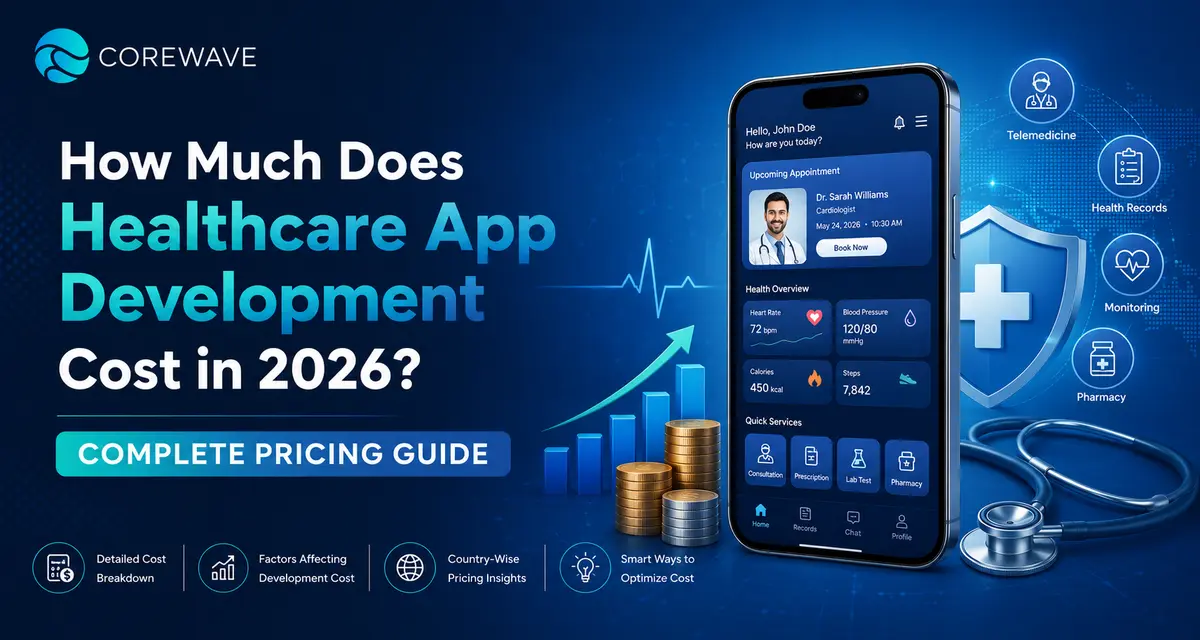

Healthcare app development costs in 2026 can range from $20,000 to $500,000+ based on the applications complexity, features set and compliance requirements, as well as the developer team you select. A basic appointment-booking or wellness tracking application can be developed for between $20,000 and $40,000. An enterprise-grade technology for telemedicine or AI-powered diagnostics can exceed $250,000.
As a trusted healthcare application development company, Corewave has helped hospitals clinics, hospitals, as well as digital health startups transform their ideas into HIPAA-compliant, secure products that users actually utilize. If youre trying to figure out a budget for your next app in the field of healthcare This guide explains the exact place where your cash will go and how to make the most of it.
Healthcare apps are web or mobile application that assists patients doctors, patients or healthcare institutions handle medical records, communications, or delivery of care. This includes the telemedicine platform, appointment schedulers, remote monitoring of patients systems and mental health apps and electronic health records (EHR) integrations. In contrast to a normal consumer application, a health app is required to manage sensitive patient information in a secure manner and must comply with the requirements of regulatory bodies like HIPAA (in the US) or GDPR (in Europe).
If youre only given thirty seconds this is the number youre looking for.
| App Complexity | Estimated Cost | Typical Timeline |
|---|---|---|
| Simple application (symptom checker appointment scheduling) | $20,000 - $40,000 | 2 to 3 months |
| Mid-complexity App (patient portal Telemedicine) | $40,000 - $150,000 | 4 to 6 months |
| Enterprise app (EHR integration, AI diagnostics) | $150,000 - $500,000+ | 8-12+ months |
These figures are based on a single platform with a minimal feature set. Add HIPAA compliance and EHR integration or AI-driven features and the numbers increase well tell the exact amount each one of them adds in this article.
Its worth taking a moment to consider the reason why the options are so broad. Ask five different companies that develop healthcare apps "how much will it cost to create an app for healthcare?" and youll likely receive five different answerstypically between $30,000 to $400,000or more. Its not because the vendors are ambiguous on purpose, it just depends on the scope. The issue isnt "whats the average price," its "what does my app require," and thats exactly what this guide will help you determine.
Before you dive into cost breakdowns, its helpful to know the market youre creating for. The global market for digital health was estimated at $660 billion by 2026. Healthcare organizations are under increasing pressure to streamline patient experiences, from billing and booking, to after-care. Healthcare data is reportedly 10 times more valuable for hackers than financial information in the dark web. This is why security and compliance arent things you can skimp to save money - theyre what makes an investment worthwhile in the first instance. Healthcare app founders who consider development costs as "the cost of doing this in a safe manner" tend to create more durable, reliable products than those who seek the lowest price possible.
A food delivery app and a health app may look similar from afar both have dashboards, logins, as well as push notifications. But the similarities stop there.
Healthcare apps handle Protected Health Information (PHI) This means that every screen every API call and each database entry needs been constructed with security and conformity in mind. A single breach of data in healthcare can cost companies an average of more than $7 million per event. This is the reason compliance isnt a choice as it is the basis that the application is built upon.
Additionally healthcare apps are often required to be integrated with existing medical devices, hospital systems insurance databases, as well as third-party pharmacy networks or labs. Each integration increases engineering time and testing cycles as well as costs. This is the main reason why the healthcare apps development cost is significantly higher than the cost of an average consumer app.
Theres also a expectation of reliability that is much more pronounced in healthcare. A social media app that crashes for an hour can be a huge inconvenience, while a telemedicine application malfunctioning during a scheduled consultation could mean that a patient isnt able to receive the time-sensitive treatment. The reliability bar is a nudge for teams to greater testing and more robust infrastructure and slower, more cautious release cycles -all of which will are reflected in the final invoice however, all of these are not negotiable once actual patients depend on your application.
Many factors determine where your projects location on the cost spectrum. Heres what is actually moving the needle.
The more functions you add into your app, the more cost. A simple appointment reminder app requires less engineering than a platform that offers video consultations, e-prescriptions as well as lab report uploads all in one location. Always begin by segregating "must-have" functions from "nice-to-have" ones as this can reduce the cost of your first version by 30-40%..
An effective exercise is to sketch out every concept idea to two tests: will this feature solve the main problem that users are facing currently, and will they even notice if something is absent on the first day? If they dont, its nearly always safe to move to the second version of the roadmap. Doing this exercise with honesty prior to your first sprint of development is among the most cost-effective methods of reducing costs without sacrificing what users require.
Building separate on iOS and Android nearly doubles the cost of development. Frameworks that cross-platform like Flutter and React Native allow you to build once and then deploy for both platforms, generally saving between 30-40% compared to two native builds. This is the best choice for healthcare startups operating on an unsustainable budget.
If your application collects or stores health information of patients, HIPAA compliance (or GDPR for those who serve European customers) is a non-negotiable requirement. Compliance work -encrypted data storage, access controls audit logs and secure authentication generally adds 20-30 percent to your budget for development. Its a cost that you must pay for but its also the thing that keeps your company from being in trouble with the law and your customers trust in place.
Connecting your application to Electronic Health Record systems like Epic or Cerner is among the most technical aspects of developing a healthcare application. EHR integration alone can cost an additional $15,000 to $50,000 depending on the number of systems you have to connect to.
A video consultation system, AI-based symptom monitoring and health predictive analytics require specialist engineering and, typically regular API costs. AI-powered healthcare applications generally cost more upfront, but can cut the operational cost in the long run through automation of tasks that normally require human workers.
The location where your development team is where they are based has a greater impact on costs than people think.
| Region | Hourly Rate | Mid-Complexity App Cost |
|---|---|---|
| United States | $120 - $200/hr | $200,000 - $400,000 |
| Eastern Europe | $40 - $80/hr | $80,000 - $150,000 |
| India / Southeast Asia | $25 - $50/hr | $40,000 - $100,000 |
Selecting a seasoned nearshore or offshore team, such as Corewave can cut the total project costs by 30-50%, without losing quality so long as the team has a track record of expertise in healthcare and compliance.
Healthcare apps are able to serve a broad variety of users ranging from advanced patients to seniors with chronic illnesses therefore design isnt only about aesthetics its about trust and accessibility. A rush-like UI can result in medical errors or missed appointments which is why the majority of healthcare apps allocate 15-20% of all costs to conduct research, wireframing and usability testing on their own.
In addition to EHR systems, a lot of healthcare applications also require connect to insurance verification APIs pharmacie networks and lab result providers as well as payment gateways. Each integration can cost between $5,000 and $20,000 based on how well-documented the API of a third party is and the amount of custom mapping your data needs.
The cost of bringing your app in operation is only the beginning. As your user base expands it will be necessary to increase the size of your servers, track performance and constantly patch security holes. Many healthcare companies underestimate this ongoing investment the exact figures are provided in the section below on hidden costs.
Different types of healthcare apps come with a variety of prices. Heres a detailed breakdown of costs by the type of app.
Telemedicine applications require live streaming of video in real-time secure chat, appointment schedulers as well as payment integration. Plan to invest between $60,000 and $150,000 depending on the quality of the video specifications and if you require integration with remote monitoring devices or wearable hardware.
Apps for patient engagement include appointment reminders as well as health education content and symptom tracking are the cheapest level of pricing for healthcare apps generally, costing between $40,000 and $80,000. These are an excellent starting place for healthcare professionals to test the waters of digital tools.
RPM apps work with medical devices and wearables to monitor vital indicators like blood pressure and heart rate in real-time, alerting medical professionals when readings are unusual. Due to the hardware-based real-time data processing and synchronization required, RPM apps typically cost between $80,000 and $150,000.
Mental health apps usually include mood monitoring as well as guided therapy modules as well as instant chat with therapistsfeatures that require additional attention to privacy concerns of the user. The cost of these apps tends to vary between $60,000 to $130,000 and can rise to the upper price when AI-driven personalization features are added.
Apps that are built around electronic health recordsproviding patients and doctors access to medical history prescriptions, medications, and lab results - are among the more expensive to develop with prices ranging between $150,000-$350,000+ mostly because of the complexity of integration and the cost of compliance.
Apps that make use of AI or machine learning to aid in diagnosis, risk prediction or for clinical decision-making are in the middle of the cost scale, usually costing between $150,000 and $300,000+. They require specialized data science expertise, in addition to normal app development tasks.
If youd like to create an affordable feature-by-feature budget instead of a category for apps Heres a rough estimate of what each of the features will cost you to add to.
| Feature | Estimated Cost |
|---|---|
| User onboarding & profile management | $3,000 - $8,000 |
| Appointment scheduling | $5,000 - $12,000 |
| Secure in-app messaging | $6,000 - $15,000 |
| Video consultation (telemedicine) | $15,000 - $40,000 |
| Push notifications and reminders | $2,000 - $5,000 |
| Integration of Payment Gateways | $4,000 - $10,000 |
| Wearable device sync | $10,000 - $25,000 |
| AI symptom checker | $20,000 - $50,000 |
| Integration of EHR and EMR | $15,000 - $50,000+ |
| HIPAA-compliant data storage & encryption | $10,000 - $30,000 |
By adding these numbers together, you get an accurate, feature-level overview of the direction your healthcare apps development budget is getting you -which is much more valuable than a simple ballpark figure.
The technology you choose affects the cost performance, as well as how easily your app can scale in the future.
Selecting HIPAA-compliant cloud services from providers such as AWS or Azure from the beginning will help avoid costly infrastructure migrations later.
The development of healthcare apps covers much beyond hospitals. Corewave develops applications for:
Your development invoice isnt the only bill youll pay. These often-overlooked costs catch founders off guard.
Making these plans from the beginning helps avoid budget shocks that occur six months after the launch. Founders who incorporate these numbers into their initial estimate of the healthcare app development cost instead of putting them in a separate spreadsheet and considering them as a last-minute thingalways avoid funding gaps that stop many promising health apps following their first launch which is when user growth begins to put the pressure on support and infrastructure costs.
The cost of lowering your budget doesnt need to mean cutting your standards. These are the ways that smart startups in healthcare can keep costs under control.
Its worth spending more time focusing on compliance, because its the biggest cost-driver that founders often overlook. HIPAA compliance isnt something that you check at the end of development. It should be incorporated into your structure right from the start.
Heres what the 20-30% compliance cost typically is:
Doing nothing to save money in the beginning is one of the biggest mistakes a healthcare company can make. Fines from regulatory authorities for HIPAA violations can be in the millions, far exceeding what youve could have saved by focusing on development.
If youre developing for European users GDPR compliance adds its own set of requirements pertaining to data transferability, the right to be forgotten and the management of explicit consent which is worth planning to separate if youre trying to reach an international user base.
Founders often ask whether healthcare app development cost is actually worth it. The short answer is: for those who have the right build it will pay for itself in a short time. Digital tools for engagement with patients frequently reduce missed appointments by using automated reminders, reduce administrative expenses by digitizing intake and scheduling and increase retention of patients by making healthcare more accessible during non-clinical hours. Telemedicine platforms have extended the accessibility of healthcare providers beyond their geographical location, allowing completely new patient populations that were not available before the advent of virtual healthcare. The companies that have the greatest returns are ones that approach their application as a long-term solution with an ongoing maintenance and iteration budget as opposed to an initial build.
We use a proven six-stage process specifically designed for products used in healthcare.
Healthcare app development isnt a secondary area of expertise for us; its our primary goal. Our team has developed telemedicine platforms as well as patient engagement apps and EHR-integrated systems to customers across the US, Europe, and Asia and consistently delivers HIPAA-compliant solutions in time and on budget. We provide you with a clear cost breakdown before you begin development so that there arent any surprises at the end of your project.
Get a free Health Application Cost Estimate Talk to our team to receive an accurate, no-obligation quote for your application.
Healthcare app development costs range between $20,000 for a basic MVP to $500,000+ for an enterprise platform that includes AI as well as EHR integration. The majority of mid-complexity apps cost between $40,000 to $150,000.
HIPAA compliance usually adds 20% to 30% of the total development budget including secure data storage access control, audit logs as well as secure authentication.
The timeline depends on the how complex the app is: a simple application takes a couple of months and a complex app takes 4 to 6 months, and an enterprise platform that has EHR integration can take between 8 and 12 months or more.
Yes. AI-powered features such as predictive analytics or diagnostic support generally push project costs towards the $150,000-$300,000+ mark due to the highly specialized work in data science although they typically reduce the long-term costs of operation.
Yes. Making apps using Flutter or React Native instead of separate native iOS and Android apps can save you 30-40 percent on the initial development as well as long-term maintenance.
Start with an MVP focusing on a couple of fundamental features -- such as appointment scheduling or secure messaging is the most efficient option typically starting at about $25,000.
EHR/EMR integration usually costs $15,000 to $50,000 or more, based on the number of systems and data formats your application needs to connect to.
Yes. It is recommended to budget 15-20 percent of the development costs annually to pay for updates bugs security patches, and OS compatibility.
Offshore teams operating in regions like India or Eastern Europe typically charge $25-$80/hour as opposed to $120-$200/hour for American-based teams, which can reduce total cost of projects by 30-50%, without any compromise in quality if the team has experience in healthcare.
After the initial development, you can expect charges for security audits ($3,000-$30,000+ per audit) as well as app store charges cloud hosting that is HIPAA compliant and user acquisition along with the maintenance budget you set for each year.
Both models are applicable to the project you are working on. Fixed-price contracts are best for small, well-defined projects (like the MVP with an unlocked feature list) and time-and-materials pricing is more appropriate for longer projects that may require changes the majority of enterprise healthcare projects use this model to provide flexibility.
Yes. Apps that display only general health information require less compliance than apps that handle PHI directly, such as EHR platforms, or telemedicine applications that use chat and video. The more patient information your app interacts with the more compliance-related engineering is required.
If you are building a middle-complexity app that costs $80,000 to $150,000, you should you should plan to add an additional $15,000-$30,000 in annual costs for maintenance hosting, security audits, hosting and the an initial acquisition of users approximately 20-25% over the top of your budget for development.
Are you looking to create an HIPAA-compliant and secure healthcare app without squeezing your budget? Contact Corewaves app development developers to get an unbeatable, comprehensive cost estimate that is tailored to your particular project.